
If you’re planning to sit the PMP® exam in 2026, you need to know that PMI has made its most significant certification update in years. The PMP exam changes 2026 cycle is not a cosmetic refresh — it’s a structural rebalancing of what the exam tests, how it tests it, and what a “competent project manager” is now assumed to know.
This guide breaks down exactly what changed, why PMI made these changes, how the new PMP Examination Content Outline (ECO) compares to the retired 2021 version, how it aligns with the newly released PMBOK® Guide 8th Edition, and what a practical 2026 study plan looks like — whether you’re a working project manager, a CAPM holder moving up, or an IT, construction, healthcare, or finance professional pursuing your first PMP.
Key Takeaways
- PMI’s updated PMP Examination Content Outline took effect in July 2026.
- The three domains remain People, Process, and Business Environment, but weightings shifted significantly: People 33%, Process 41%, Business Environment 26%.
- Business Environment nearly tripled in weight (from 8% to 26%) — the single biggest structural change.
- The exam is still 180 questions (170 scored, 10 pretest) in 240 minutes, with two 10-minute breaks.
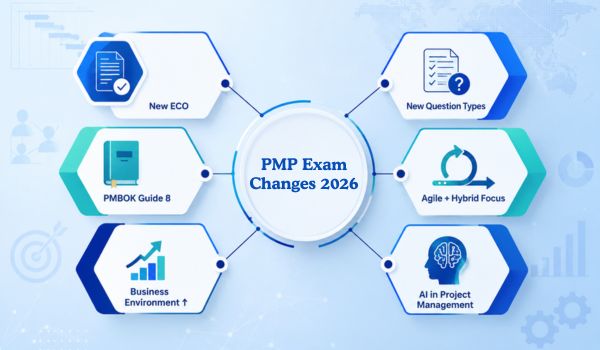
- Three new question formats were introduced: Case/Scenario questions, Enhanced Matching, and Graphic-Based questions.
- PMBOK® Guide 8th Edition (408 pages, published November 2025) reorganizes the standard around six core principles and seven performance domains, with expanded coverage of AI, PMOs, and procurement.
- Eligibility requirements now reference international education-framework levels (EQF/ISCED) rather than only “bachelor’s degree” or “associate’s degree” language.
- Commercial training (35 hours), the 3-attempts-per-year retake policy, and the 60-PDU/3-year renewal cycle are unchanged.
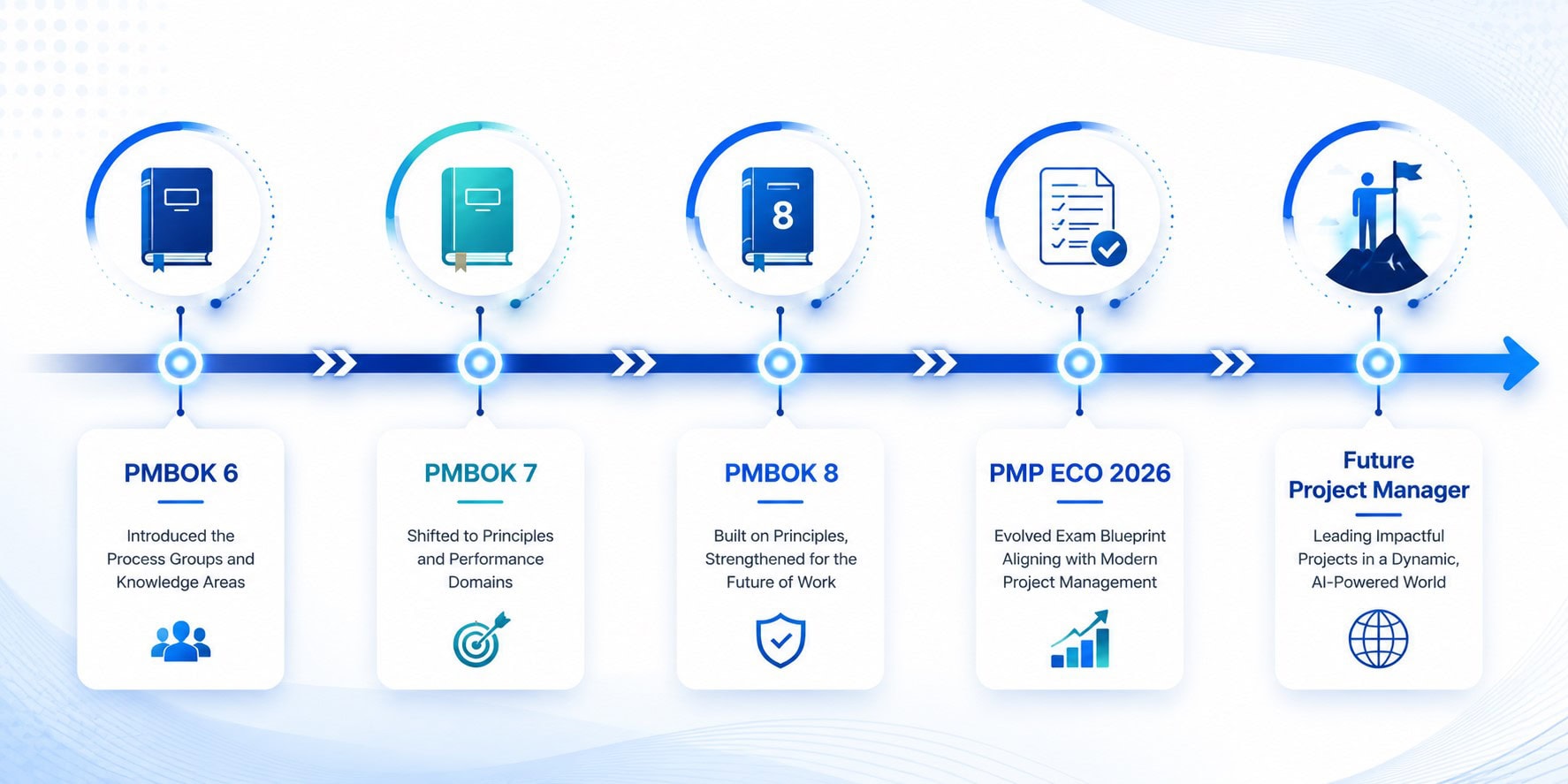
It’s worth repeating something PMI states directly in its own ECO document: the PMP exam is not “based on” the PMBOK Guide. The ECO is developed independently through a Job Task Analysis (JTA), a research process where PMI surveys practicing project managers about what they actually do on the job. The PMBOK Guide is one of several references that inform, but don’t dictate, the exam blueprint. Candidates who study PMBOK Guide chapters without cross-referencing the ECO risk misallocating their prep time.
That said, the two updates were clearly designed to move in the same direction: toward business value, adaptability across predictive/agile/hybrid delivery, and a more judgment-based (rather than definition-based) style of testing.
Why PMI Updated the Exam
PMI’s stated rationale, drawn from its JTA research, centers on how the day-to-day reality of project delivery has shifted:
- Business Environment concerns have grown sharply — governance, compliance, risk-to-business-outcomes, and organizational change now occupy a much larger share of a project manager’s actual workload than the old 8% weighting reflected.
- Delivery approaches have diversified. Predictive-only projects are now a minority of real-world work; agile and hybrid approaches dominate.
- New trends needed formal recognition. PMI explicitly cites artificial intelligence and sustainability as inputs validated through the JTA process for their relevance to real project work.
- Assessment style needed to evolve. PMI has moved toward scenario- and case-based judgment questions rather than recall-based questions, which is why three new question formats were introduced.
What Is the New ECO?
The PMP Certification Exam Content Outline is PMI’s official blueprint: every scored question on the exam maps to a task inside it. The current version was developed by Alpine Testing Solutions (PMI’s retained psychometric and test-development partner) through a global Job Task Analysis and took effect as the “PMP Examination Content Outline – July 2026 Update.”
Domain, Task, and Enabler Structure
The ECO defines three levels:
- Domains — high-level knowledge areas (People, Process, Business Environment)
- Tasks — the underlying responsibilities within each domain (26 tasks total: 8 People, 10 Process, 8 Business Environment)
Enablers — illustrative (non-exhaustive) examples of what each task looks like in practice
PMBOK® Guide 8th Edition Overview
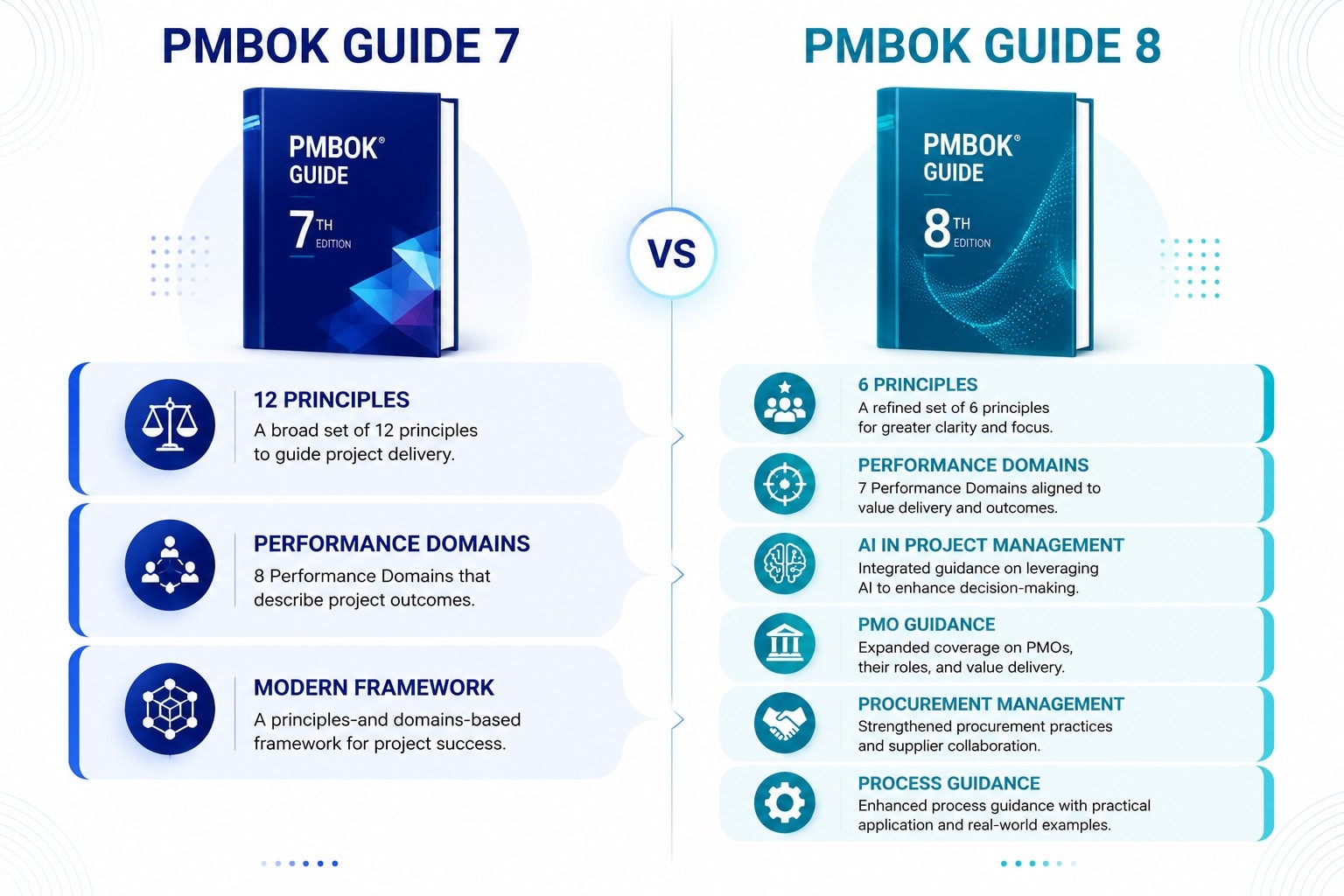
The PMBOK® Guide – Eighth Edition, published by PMI in November 2025, is a 408-page standard built on more than 48,000 data points gathered from practitioner research. It keeps the principles-and-performance-domains architecture introduced in the 7th Edition but simplifies it for practical application. Per PMI’s own product description, it includes:
- Six core principles guiding effective project management behavior (down from twelve principles in the 7th Edition)
- Seven performance domains covering governance, scope, schedule, finance, stakeholders, resources, and risk
- Expanded coverage of AI, PMOs, and procurement, with process guidance reintroduced in a non-prescriptive, evolved form
- A continued emphasis on value delivery, adaptability, and accountability
Comparison Table: PMBOK 7 vs PMBOK 8
| Feature | PMBOK® Guide 7th Edition | PMBOK® Guide 8th Edition |
| Published | August 2021 | November 2025 |
| Core Principles | 12 | 6 |
| Structure | Principles + Performance Domains | Principles + Performance Domains + reintroduced Process guidance |
| Process Detail | Largely removed in favor of principles | Reintroduced, non-prescriptive, evolved format |
| AI Coverage | Minimal | Expanded, dedicated coverage |
| PMO Coverage | Limited | Expanded |
| Procurement Coverage | Limited | Expanded |
| Length | ~250 pages | 408 pages |
| Underlying Research | Practitioner input | 48,000+ data points, global practitioner collaboration |
Comparison Table: Old ECO vs New ECO
| Feature | 2021 ECO (retired) | July 2026 ECO (current) |
| Effective period | January 2021 – July 8, 2026 | From July 9, 2026 |
| Domains | People, Process, Business Environment | Same three domains (unchanged) |
| People weighting | 42% | 33% |
| Process weighting | 50% | 41% |
| Business Environment weighting | 8% | 26% |
| Total exam questions | 180 (170 scored, 10 pretest) | 180 (170 scored, 10 pretest) — unchanged |
| Exam duration | 230 minutes | 240 minutes |
| Question formats | MCQ, multiple-response, matching, hotspot, drag-and-drop | Adds Case/Scenario, Enhanced Matching, Graphic-Based |
| Predictive vs Agile/Hybrid split | Roughly half agile/hybrid | ~40% predictive / ~60% agile & hybrid |
| Retake policy | 3 attempts per 1-year eligibility window | Unchanged |
| Continuing certification | 60 PDUs / 3 years | Unchanged |
Domain Weightage: People, Process, Business Environment
The PMBOK® Guide – Eighth Edition, published by PMI in November 2025, is a 408-page standard built on more than 48,000 data points gathered from practitioner research. It keeps the principles-and-performance-domains architecture introduced in the 7th Edition but simplifies it for practical application. Per PMI’s own product description, it includes:
Domain I — People (33%)
Eight tasks covering shared vision, conflict management, team leadership, stakeholder engagement and expectation alignment, knowledge transfer, and communication planning. The weighting dropped nine points, but PMI’s own framing emphasizes judgment-based leadership over procedural people-management — the questions get harder to game with memorization, not less important.
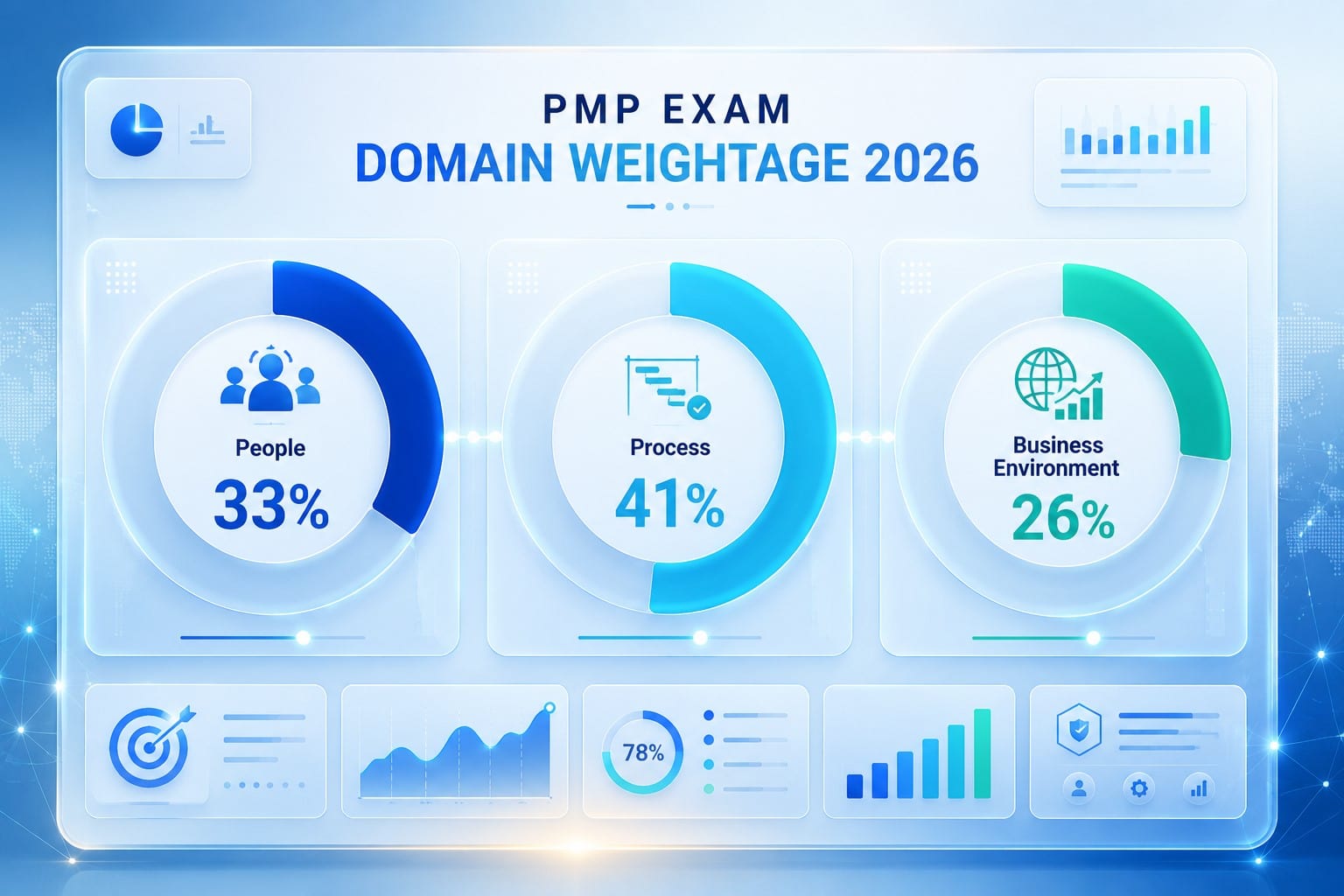
Domain II — Process (41%)
Ten tasks — the largest task count of the three domains — spanning integrated planning, scope, value-based delivery, resources, procurement, finance, quality, schedule, status evaluation, and closure. This domain now explicitly requires candidates to recommend a development approach (predictive, adaptive/agile, or hybrid) as part of planning, rather than treating methodology choice as a separate topic.
Domain III — Business Environment (26%)
Eight tasks covering governance, compliance, change control, impediment removal, risk, continuous improvement, organizational change, and — new in emphasis — evaluating external business environment shifts (regulatory, technological, geopolitical, market). This domain’s near-tripling in weight is the clearest signal that PMI now expects PMP holders to operate as business partners, not just delivery coordinators.
Predictive vs Agile vs Hybrid Weightage
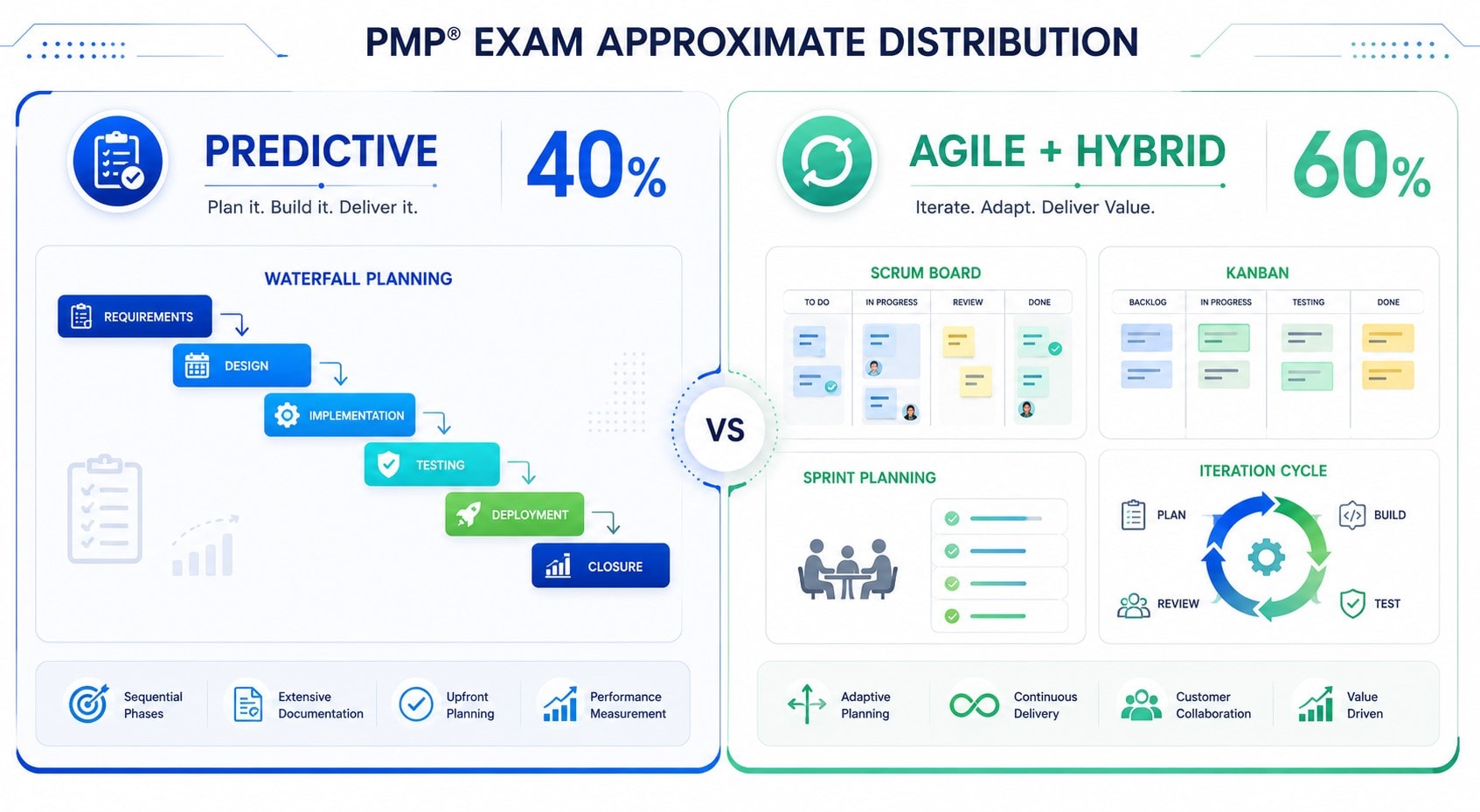
PMI states plainly in the ECO that predictive, adaptive/agile, and hybrid approaches are woven through all three domains rather than isolated into one section. Approximately 40% of exam items reflect predictive approaches, with the remaining 60% split between adaptive/agile and hybrid approaches. This is a meaningful shift for candidates who trained primarily on waterfall-style project management — agile and hybrid scenario fluency is no longer optional.
New Exam Question Formats
Three new formats were confirmed by PMI:
- Case or Scenario questions — a detailed situation (business, project, or decision-making context), sometimes with charts, followed by a series of related questions.
- Enhanced Matching — matching questions that may include images or diagrams, with drag-and-drop functionality (computer-based testing only).
- Graphic-Based questions — require interpreting charts, graphs, diagrams, or images to answer.
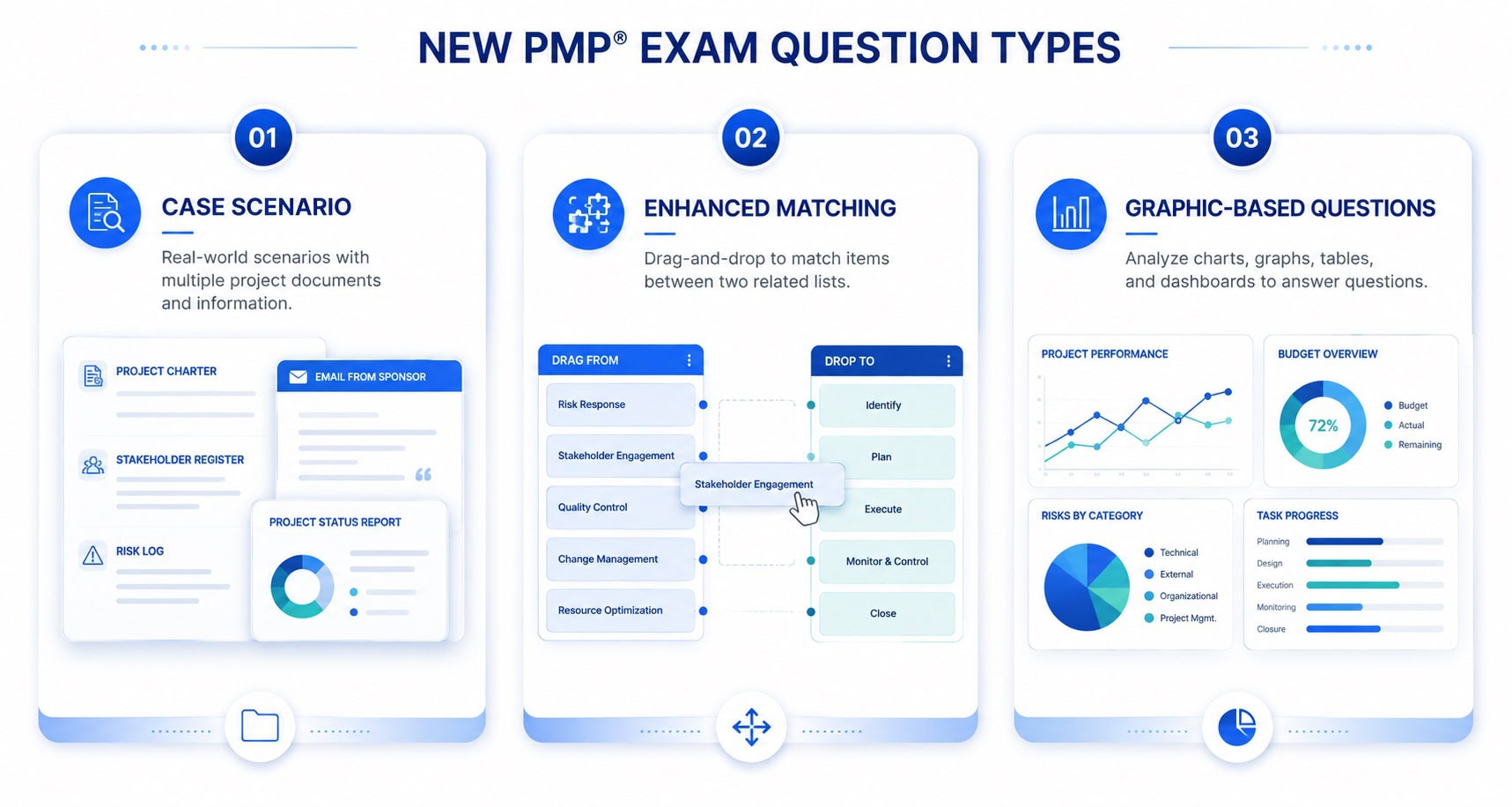
These sit alongside existing formats: multiple-choice single response, multiple-response, point-and-click, matching, and pull-down list questions.
New Competencies and Business Acumen
The rebalanced ECO puts real weight behind competencies that were previously secondary:
- Recommending a development approach based on project complexity and magnitude
- Demonstrating value-based delivery and measuring benefits realization
- Evaluating external business environment changes and their impact on project scope/backlog
- Financial planning, contingency allocation, and reserve management
Sustainability considerations woven into quality, risk, and compliance tasks
AI in Project Management
PMI explicitly names artificial intelligence as one of the trends validated through its Job Task Analysis and incorporated into both the ECO and PMBOK® Guide 8th Edition, which carries expanded AI coverage. This doesn’t mean the exam tests AI tools directly — it means AI-aware judgment (knowing when and how AI fits into project decision-making, data collection, and reporting) is now a legitimate scenario context candidates should expect.

Study Strategy and Preparation Roadmap
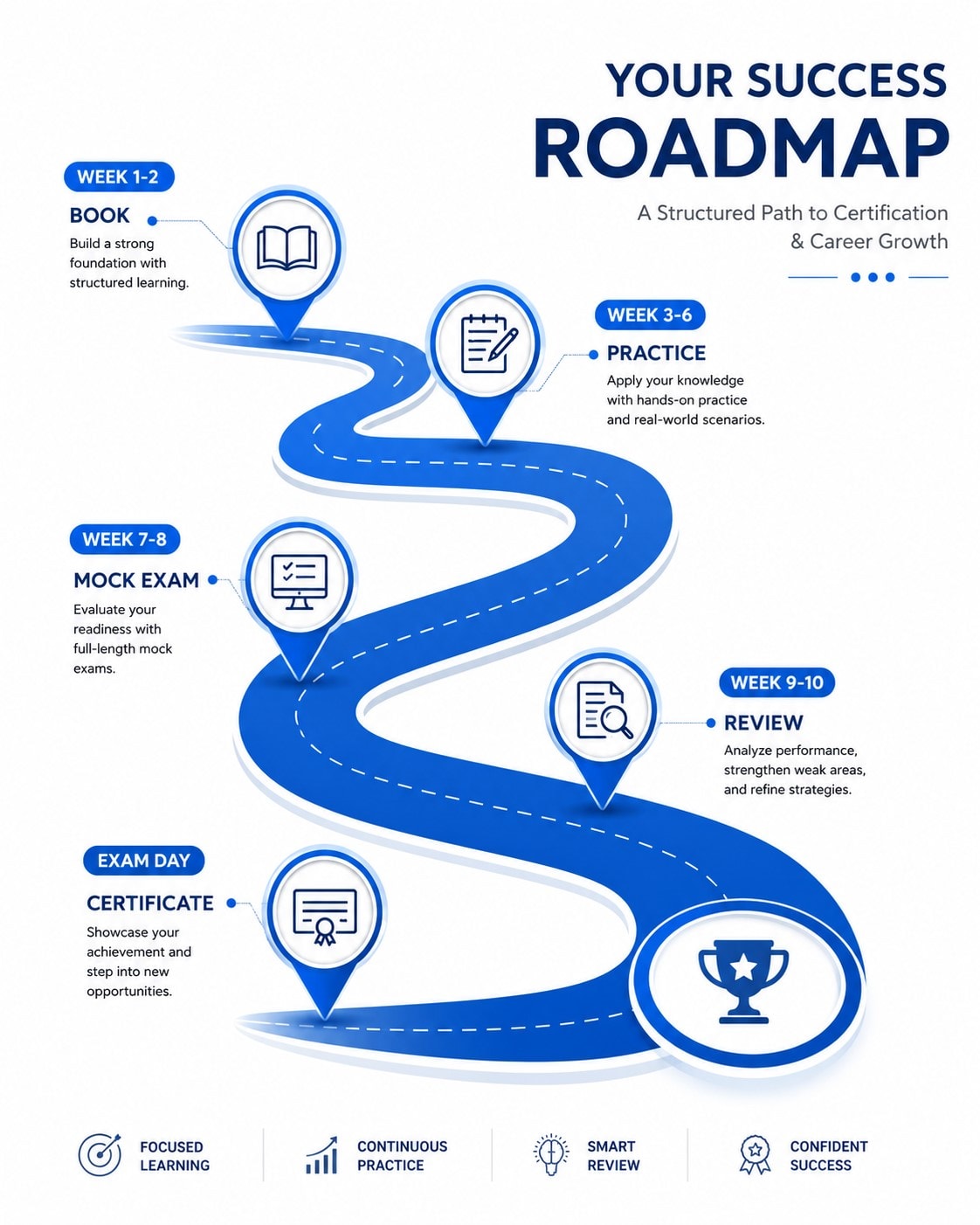
| Timeframe | Focus |
| Weeks 1–2 | Read the official PMI ECO document cover to cover; map it against PMBOK® Guide 8 performance domains |
| Weeks 3–6 | Domain-proportional study: roughly 41% Process, 33% People, 26% Business Environment |
| Weeks 7–8 | Agile/hybrid scenario practice — target at least 60% of practice questions in agile/hybrid contexts |
| Weeks 9–10 | Timed full-length mock exams using the new question formats |
| Final week | Review weak domains, rest, confirm exam-day logistics |
Study Resources
| Resource Type | Examples |
| Official PMI documents | PMP Examination Content Outline (free PDF), PMBOK® Guide 8th Edition |
| Instructor-led training | PMI Authorized Training Partner (ATP) courses |
| Practice exams | Full-length mocks aligned to the July 2026 ECO weighting |
| Community | PMI local chapters, PMI Infinity AI tool, PMI online community |
Common Mistakes to Avoid
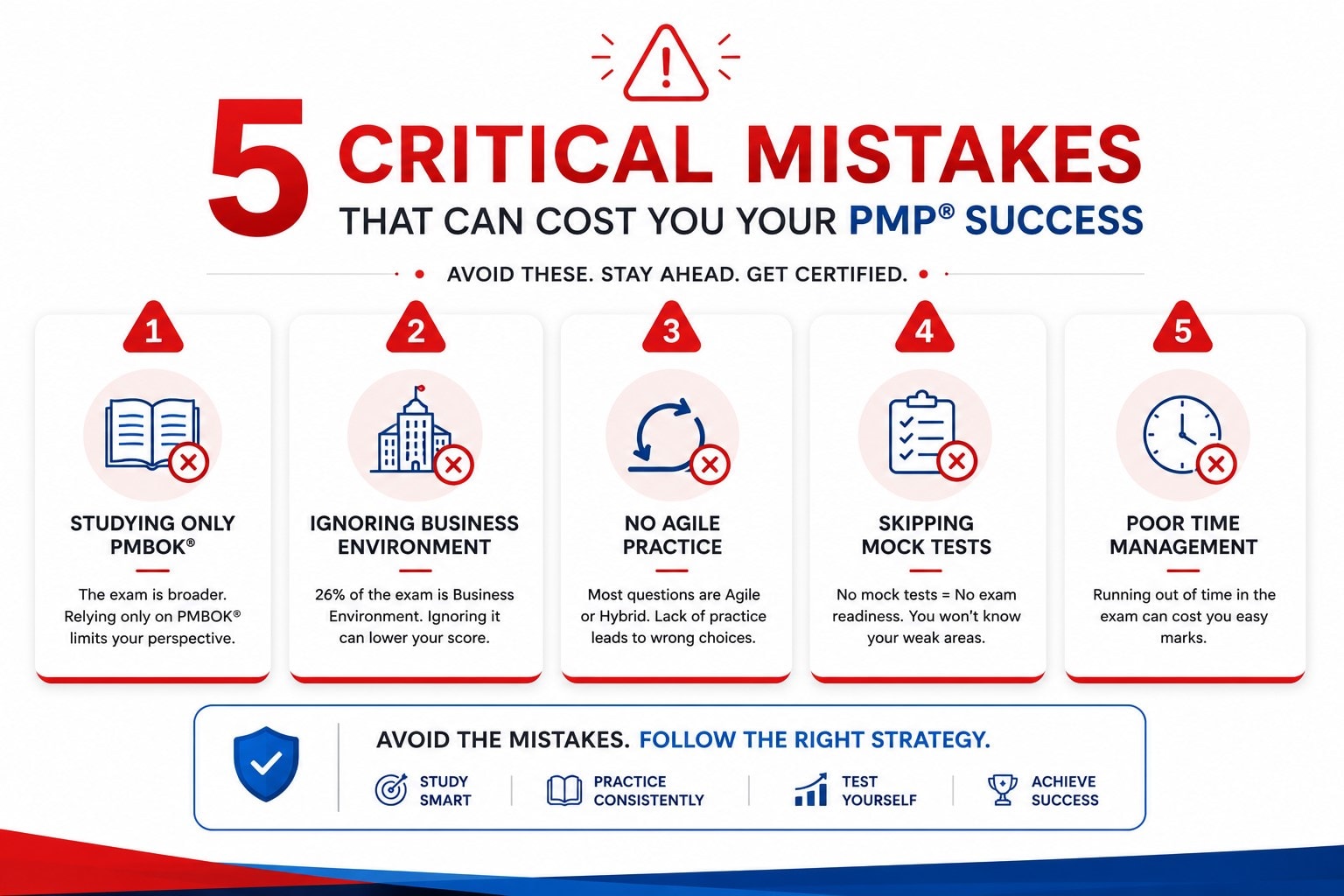
- Studying only the PMBOK Guide and skipping the ECO — the ECO, not the PMBOK Guide, defines what’s tested.
- Ignoring the Business Environment domain because it was small in the old exam — it’s now more than triple the previous weight.
- Underpracticing agile/hybrid scenarios if your real-world background is predominantly predictive/waterfall.
- Assuming eligibility rules are unchanged — the new outline maps education levels to EQF/ISCED frameworks; if your credential doesn’t clearly map, plan extra time for documentation.
- Trusting unverified “version number” claims (like “ECO 4.1”) from blogs instead of checking PMI’s own published outline.
1. When did the new PMP exam take effect?
The updated ECO and exam format took effect in July 2026.
2. Is the PMP exam still 180 questions?
Yes. It remains 180 total questions — 170 scored and 10 unscored pretest questions — over 240 minutes.
3. What are the three PMP exam domains in 2026?
People (33%), Process (41%), and Business Environment (26%) — the same three domains as before, with rebalanced weightings.
4. Why did Business Environment weighting increase so much?
PMI’s Job Task Analysis found that governance, compliance, risk-to-business-outcomes, and organizational change now occupy a much larger share of real project managers’ work than the previous 8% weighting reflected.
5. Is the PMP exam based on the PMBOK Guide?
No. PMI states directly that the exam is built from the ECO via Job Task Analysis, not from the PMBOK Guide. The PMBOK Guide is a supporting reference, not the exam syllabus.
6. What’s new in the PMBOK Guide 8th Edition?
Six core principles (down from twelve), seven performance domains, reintroduced non-prescriptive process guidance, and expanded coverage of AI, PMOs, and procurement.
7. How much of the exam covers agile and hybrid approaches now?
Approximately 60%, against roughly 40% for predictive approaches, woven across all three domains rather than isolated to one.
8. Are there new question types on the 2026 exam?
Yes — Case/Scenario questions, Enhanced Matching, and Graphic-Based questions are new additions.
9. Did the eligibility requirements change?
The structure of experience/education tiers is similar, but education levels are now mapped to international EQF/ISCED frameworks rather than only “bachelor’s degree” or “associate’s degree” terminology.
10. Did the commercial training hour requirement change?
No. Candidates still need a minimum of 35 hours of project-management-related commercial training aligned to the ECO.
11. How many times can I retake the PMP exam?
Up to three attempts within your one-year eligibility period — unchanged from the prior policy.
12. What is the PMP renewal requirement?
60 professional development units (PDUs) every three years, plus the renewal fee — unchanged.
13. Do I need to buy the PMBOK Guide 8th Edition to pass the new exam?
It’s a strongly recommended reference since it aligns closely with the updated ECO’s themes, but PMI’s own guidance is that no single reference — including the PMBOK Guide — is the exam syllabus.
14. Does the exam still test predictive/waterfall project management?
Yes — roughly 40% of items still reflect predictive approaches; it hasn’t been eliminated, just rebalanced.
15. Who developed the new ECO?
PMI retained Alpine Testing Solutions, a psychometric and test-development firm, to lead the Job Task Analysis and outline development.
16. Is AI directly tested on the PMP exam?
AI awareness is incorporated as a validated trend influencing task relevance, but the exam is not a technical AI exam — expect AI-aware judgment scenarios rather than AI trivia.
17. Should I take the exam before or after the July 2026 change if I’m mid-preparation?
This depends on how far along your current study plan is and which materials your training provider has aligned to. If you’re more than halfway through predictive-heavy, old-ECO-aligned prep, discuss timing with your training provider rather than assuming either path is automatically better.
The PMP exam changes 2026 represent the most substantial rebalancing of the certification in years — not because the fundamentals of project management changed, but because PMI’s research confirmed that real project managers now spend far more of their time on business governance, compliance, and cross-approach delivery judgment than the old exam weighting assumed. Combined with the PMBOK® Guide 8th Edition’s leaner six-principle, seven-domain structure and its expanded AI, PMO, and procurement coverage, 2026 candidates are being tested on a genuinely more current picture of the profession.
The right response isn’t panic — it’s a study plan that matches the new domain weights, gives agile/hybrid scenarios their real share of practice time, and treats the official PMI ECO document as the actual blueprint it is.
Ready to Prepare for the 2026 PMP Exam the Right Way?
Download the free ECO 2026 Comparison PDF — a side-by-side breakdown of the old and new PMP Examination Content Outline you can use to plan your study time domain by domain.
If you’d rather not navigate this transition alone, enroll in PMP Certification Training with a PMI Authorized Training Partner. Look for a program that includes:
- Updated curriculum aligned to the July 2026 ECO
- PMBOK® Guide 8th Edition coverage
- Mock tests built around the new question formats
- Application and eligibility documentation assistance
- Live instructor-led sessions for scenario practice